
To More Inquiry





Chakrata is a quiet cantonment hill destination in western Uttarakhand, known for its deep forests, high ridges, controlled military environment, and complete absence of mass tourism noise. Unlike popular hill stations that grow around shopping streets, cafés, and leisure tourism, Chakrata developed around discipline, silence, and forest protection. Its identity is shaped not by commercial travel but by strategic importance, limited civilian movement, and a naturally slow pace of life.
Perched above deep river valleys and wrapped inside thick deodar, pine, and oak forests, Chakrata feels emotionally distant from nearby towns even though it is geographically accessible. As travelers enter the region, the visual language changes sharply. Houses become sparse, roads narrow, traffic thins, and open forest begins to dominate the landscape. The atmosphere becomes quieter within minutes of arrival.
Chakrata does not impress through instant excitement. It leaves its mark gradually through stillness, air quality, wide valley silence, and disciplined town behavior. This makes it a destination for travelers who seek removal from noise rather than accumulation of activity.
Chakrata is situated in the western part of Uttarakhand near the border of Himachal Pradesh. It sits high above the Yamuna valley and is surrounded on most sides by forested slopes and deep river gorges. The town functions primarily as a military cantonment, and this single factor controls almost every aspect of its character.
The surrounding geography creates:
Because of this setting, Chakrata always feels physically upward and socially inward. It does not expand outward like commercial hill towns.
Chakrata’s personality is shaped by the presence of the Indian Army and its historical role as a strategic military outpost. Civilian tourism exists here, but it operates within the discipline of a controlled zone. Unlike free-moving tourist towns, Chakrata follows:
There are no loud marketplaces, no night entertainment zones, and no aggressive commercial tourism. Life moves in quiet cycles defined by:
This cantonment DNA gives Chakrata a personality that feels orderly, restrained, and emotionally calm.
The emotional transition into Chakrata happens quickly. As the final uphill stretch completes, the surrounding noise reduces sharply. Traffic sound fades, roadside clutter disappears, and forest density increases. Mobile signals weaken in some sections. The road begins to feel lighter.
For many travelers, the first few hours create a feeling of:
Unlike places that demand attention, Chakrata withdraws attention inward almost immediately.
Chakrata’s visual identity is built around vertical forest slopes, deep valley drops, and open sky ridges. Settlements remain hidden within trees rather than dominating the landscape. Large open ridges act as viewing platforms toward the Yamuna valley and distant mountain chains.
The townscape does not follow continuous shop lines or road bazaars. Instead, one sees:
Mornings appear sharp and cold even in summer. Afternoons remain bright but never harsh. Evenings fall quickly into shadow as the sun slips behind ridgelines.
Sound behaves differently in Chakrata due to forest enclosure and low population density. There is:
Instead, sound is dominated by:
This silence is not emptiness. It is controlled acoustic space, where sound appears only when naturally generated.
Chakrata functions more as a detachment zone than a recreational destination. Travelers come here to separate from:
This separation creates a pattern where visitors:
Chakrata does not stimulate. It subtracts.
Chakrata attracts travelers who seek depth over display.
It naturally suits:
It does not naturally suit:
The destination selects its visitors quietly through its lack of noise.
Within the wider Uttarakhand travel map, Chakrata holds a quiet western edge position. While Mussoorie represents colonial leisure, Rishikesh represents spiritual tourism, and Dehradun represents urban movement, Chakrata represents:
It does not compete with major tourist towns. It offers the opposite experience.
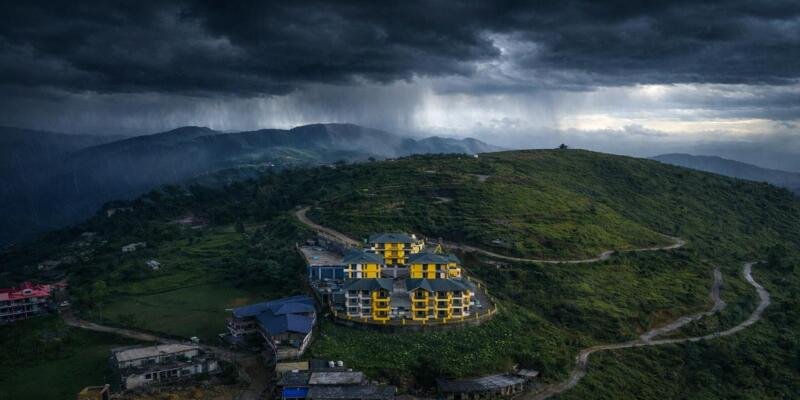
Chakrata is positioned on a high mountain ridge in the western zone of Uttarakhand, where the Himalayas begin to rise sharply from the plains of the Yamuna valley. Its geographic character is defined by steep elevation gain, deep river gorges, and long forested slopes that descend rapidly on multiple sides. This ridge-based placement gives Chakrata both its dramatic valley views and its sense of isolation.
Unlike hill towns that grow gradually upward from surrounding valleys, Chakrata sits distinctly separated from lower settlements. The ascent toward the town creates a clear physical and psychological transition—from open plains and busy roads to forest-heavy silence and thin population density.
The surrounding landscape features:
This geography prevents large-scale urban expansion and naturally preserves Chakrata’s low-density character.
Chakrata lies at a height where temperature, wind patterns, and air quality shift noticeably from nearby towns. The ridge-top elevation allows constant air movement, which keeps the environment fresh but also intensifies the cold during winters and evenings.
The ridge is not a flat tabletop. It consists of:
Because of this terrain, open land is rare. Most development is confined to narrow strips along the ridge or small forest clearings. This directly controls:
Every walk in Chakrata includes either a climb or a descent. Flat movement is limited.
One of Chakrata’s defining geographic features is its visual and environmental relationship with the Yamuna river system. Deep below the ridge, the Yamuna and its tributaries carve wide gorges through the mountains. These valleys create:
From certain ridge points, travelers can look down into vast valley spaces that feel almost bottomless during fog-heavy days. This vertical separation between ridge and river shapes Chakrata’s dramatic landscape personality.
The Yamuna valley also influences:
Chakrata is wrapped inside thick natural forest cover, which acts as both a visual shield and a climate regulator. Vast stretches of deodar, pine, and oak dominate the landscape. These forests:
Unlike hill destinations where forests are broken up by continuous construction, Chakrata remains primarily forest-first and habitation-second. Roads feel carved through trees rather than surrounded by buildings.
Forest density varies by slope direction:
This variation creates multiple micro-environments within short walking distances.
Another striking feature of Chakrata’s landscape is its cliff-dominated ridge edges. In many directions, land simply drops away from the town into deep gorge formations. These cliffs serve as:
Standing near these edges produces a strong sense of height and exposure. During clear weather, valley floors appear far below as thin green ribbons. During fog, the entire world beneath the ridge disappears, leaving only floating clouds.
These cliff systems are also responsible for:
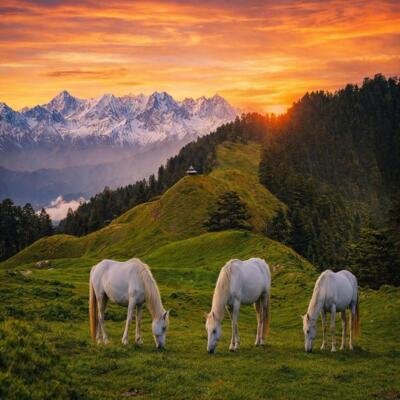
While Chakrata is mainly forest-dominated, certain ridge-top sections open into natural grassy meadows and clear ridgelines. These open spaces provide long-distance visibility and sunlight exposure.
These areas are culturally and geographically important because:
Such clearings feel almost expansive when compared with the dense forest routes that connect them.
Chakrata’s geology is shaped by layered mountain rock and loose surface soil, which is common across mid-Himalayan terrain. This soil structure supports forest growth but is also sensitive to heavy rainfall.
During monsoon:
Because of this, road movement during intense monsoon periods requires caution. However, Chakrata’s controlled construction and limited heavy infrastructure reduce large-scale slope damage when compared to overdeveloped destinations.
The steep, forested geography of Chakrata directly influences how people move:
This terrain naturally cancels out:
Instead, daily movement adopts a measured, careful, and quiet rhythm, which defines the town’s calm social personality.
Light behaves differently across Chakrata’s ridges and valleys. Mornings often begin with sharp, cold light that cuts cleanly through forest branches. By midday, sunlight fills open ridges while valleys remain partially shaded. Evenings bring long shadow lines as the sun drops behind the ridge system.
This creates:
The same viewpoint can feel completely different every few hours.
Chakrata’s natural landscape does not feel decorative. It feels commanding and inward-pulling. The height, forest density, and valley depth combine to:
This is why many travelers describe Chakrata’s geography not just as scenery, but as a psychological environment that reshapes mood and attention.
Long before Chakrata became a military cantonment, the region was inhabited by small agricultural and pastoral communities connected to the Jaunsar–Bawar tribal belt. Life here developed in isolation due to steep terrain, dense forests, and limited access routes. Villages were scattered along ridges and gentle slopes where limited farming was possible.
These early settlements were shaped by:
The region remained largely cut off from large political centers for centuries. This isolation allowed local customs, language, and lifestyle to preserve their originality for a long time. Chakrata itself did not exist as a formal town during this period. It was simply part of a remote forested highland zone.
The broader Chakrata region formed part of the Jaunsar–Bawar area, which has a distinct tribal identity within Uttarakhand. The Jaunsari people developed a cultural life deeply connected to:
Unlike the temple-focused culture of Garhwal and Kumaon, Jaunsari traditions historically carried strong elements of nature worship, folk rituals, and community gatherings. Music, dance, and oral storytelling played an important role in preserving cultural memory.
Even today, traces of this tribal influence can be seen in:
Although Chakrata later transformed into a cantonment town, the surrounding villages still carry this older cultural layer.
Chakrata entered recorded modern history during the British period when colonial surveyors began exploring the western Himalayan ranges for strategic military locations and cooler summer stations. Due to its:
Chakrata was selected as a strategic military cantonment site rather than a leisure hill station. Unlike Mussoorie, which was developed for colonial recreation, Chakrata was developed primarily for defense planning and controlled military presence.
The British established:
Civilian movement was limited even during this early phase. This decision became the foundation of Chakrata’s disciplined town character.
Once established as a cantonment, Chakrata’s development followed military needs rather than civilian growth. Infrastructure was created to support:
There was no attempt to create market boulevards, entertainment centers, or large civilian settlements. Everything was built with:
This planning model permanently set Chakrata apart from other hill towns. The town was never meant to attract mass population influx. It was meant to remain controlled, quiet, and strategic.
After India gained independence, Chakrata remained under military control and continued functioning as a cantonment. The Indian Army took over the operational command and retained:
Civilian settlement remained limited and regulated. Even today, a large portion of Chakrata’s land and infrastructure belongs to the defense establishment. This continuous military presence ensures that:
Unlike tourist towns where growth is driven by commercial opportunity, Chakrata’s growth has always been driven by strategic necessity and security planning.
Military influence in Chakrata does not feel dominant or intimidating. Instead, it creates a subtle background of order and restraint. Daily life in Chakrata naturally follows:
There is no nightlife culture. Shops close early. Roads fall silent by evening. This is not due to lack of tourism but because of the institutional rhythm of a cantonment environment.
Even civilian residents subconsciously adopt:
This creates a town atmosphere that feels calm, safe, and emotionally stable.
Tourism in Chakrata developed slowly and naturally without aggressive promotion. For a long time, Chakrata remained:
Even today, tourism operates under clear boundaries:
This keeps tourism low-impact and controlled, preserving the town’s silence and ecological balance.
Unlike open hill stations where tourists dominate the town atmosphere, in Chakrata, tourists remain guests within a functioning military environment.
Chakrata’s architectural style reflects its cantonment origin rather than traditional hill-town evolution. Structures are:
Wide empty roads, administrative blocks, barracks, and residential settlements appear without commercial layering. There is no heritage bazaar architecture or colonial leisure design here. The visual language of the town remains:
Even newly built structures generally follow this understated design identity.
A unique aspect of Chakrata is the coexistence of civilian life and military space. Civilians live, work, and trade within clearly defined areas, while large forest and cantonment zones remain exclusively under defense control.
This relationship creates:
Visitors quickly learn to identify where movement is allowed and where it is not. This clarity prevents chaos and keeps the town emotionally stress-free.
Chakrata’s modern identity is a direct continuation of its cantonment history. It did not pass through phases of:
Instead, it moved directly from: Remote tribal highland → British cantonment → Indian Army cantonment → Controlled civilian tourism town
This singular historical path explains why Chakrata feels:
It is not a town that reinvented itself for tourism. It is a town that allowed tourism to enter within its existing military order.
Chakrata is not built around crowded sightseeing circuits. Its important places are deeply tied to forests, ridgelines, waterfalls, caves, and open valley edges. Most locations are experienced through walking, quiet observation, and seasonal change rather than through commercial tourism pressure. Each place carries a strong natural personality, shaped by silence, height, and isolation.
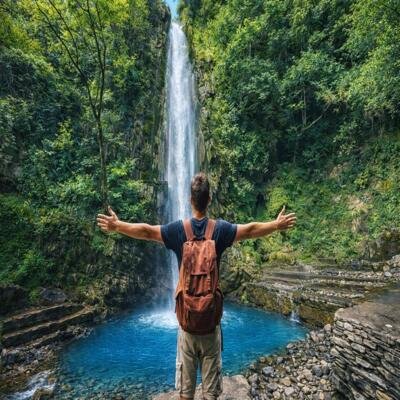
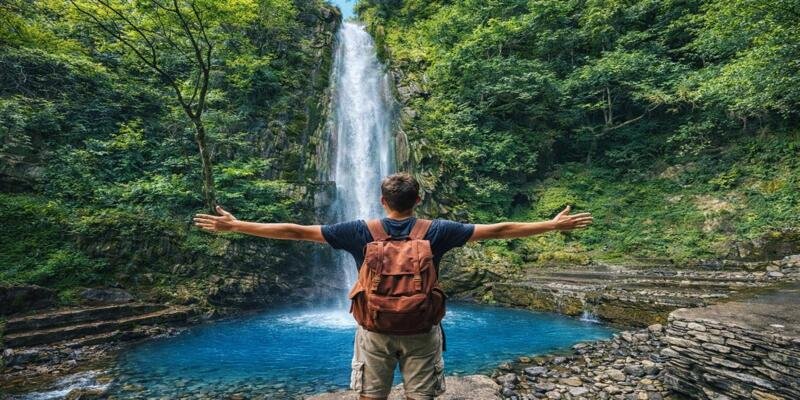
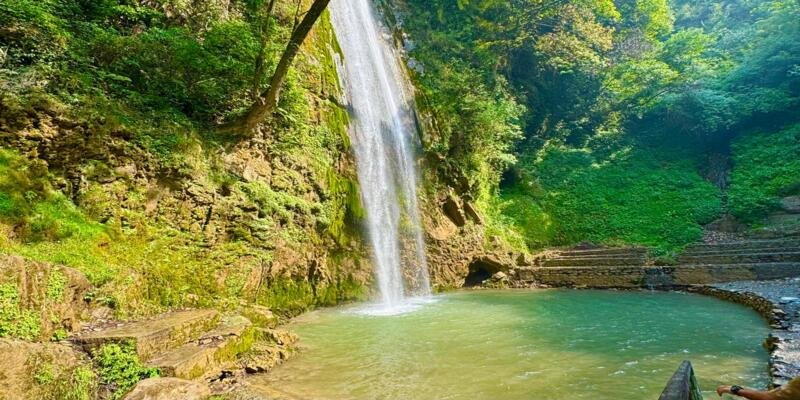
Tiger Falls is the most powerful and visually dramatic waterfall in the Chakrata region. The waterfall drops forcefully through a forest gorge, surrounded by steep rock walls and dense tree cover. The approach involves a downhill forest walk, which adds to the sense of entering a hidden natural chamber.
During the monsoon, the waterfall becomes thunderous, and mist fills the surrounding space. In summer, the water flow remains steady but more controlled, allowing closer viewing and longer sitting time.
Why Tiger Falls stands out:
Budher Caves lie in a remote forest-meadow zone above Chakrata and are linked with local legends and shepherd traditions. The area is characterized by wide grassy clearings, limestone cave formations, and surrounding forest ridges. The caves themselves are quiet, dark, and naturally formed, creating a strong sense of primitive landscape.
The journey toward Budher is as important as the destination. Forest roads, open slopes, and sudden valley drops create a slow unfolding of space.
Why Budher Caves feel unique:
Chilmiri Neck is one of the most important ridge-top viewpoints in Chakrata. From here, travelers experience a wide-angle opening of valleys and distant mountain chains. The open ridge allows continuous wind movement and clear sky visibility during most non-monsoon months.
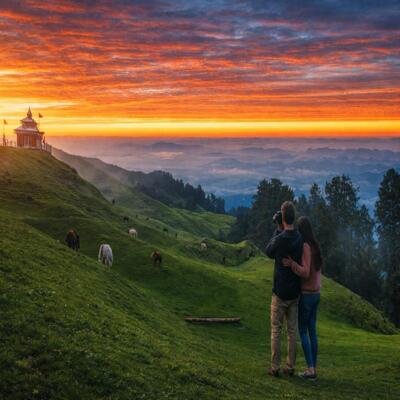
It is a favored place for sunrise and sunset observation. Light moves slowly across ridges and valleys, creating layered color movement.
Why Chilmiri Neck is significant:
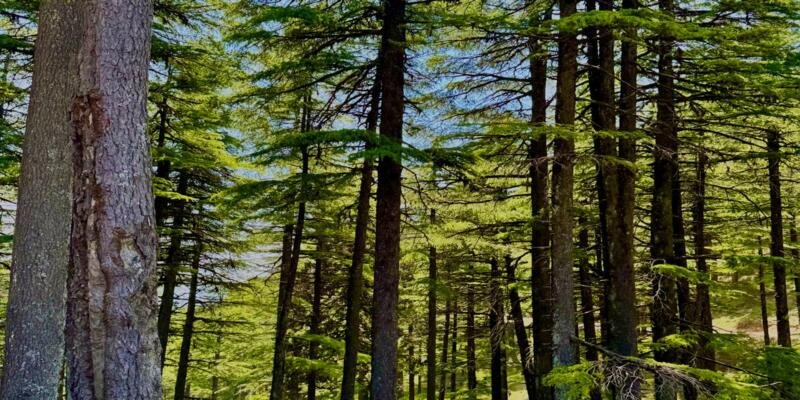
Deoban is a dense forest region filled with tall deodar trees that create a cathedral-like walking environment. Light filters in narrow beams, and sound becomes absorbed by thick bark and undergrowth. The forest feels ancient, heavy, and extremely quiet.
The path through Deoban is about walking inside stillness rather than chasing a destination. In winter, frost covers fallen leaves, adding a white texture to the forest floor.
Why Deoban Forest feels powerful:
Kanasar Forest lies slightly beyond Chakrata and is famous for its one of the densest deodar forests in Asia. The trees here grow extremely tall and straight, forming wide open forest halls. Unlike darker forests, Kanasar allows more sunlight to touch the ground.
This area feels less enclosed and more expansive, making it suitable for long sitting, walking, and wide photography.
Why Kanasar Forest is visually special:
Ram Tal is a small, calm garden zone used mainly for horticulture and quiet sitting. Surrounded by trees and hill slopes, the area feels like a subtle pause between forest walks and valley exploration.
It is not a decorative tourist garden but a functional green space with minimal disturbance.
Why Ram Tal feels calming:
Moila Top is one of the highest accessible ridge crests near Chakrata. The top opens into wide grassy terrain with panoramic views of surrounding ranges and valley systems. Wind remains constant, and cloud movement becomes dramatic during the monsoon and early winter.
The sense of height and exposure is strongest here.
Why Moila Top feels dramatic:
Kimona Falls is a seasonal waterfall that becomes active mostly during the monsoon. The setting is narrow, forest-wrapped, and quiet. Unlike Tiger Falls, which is powerful and wide, Kimona feels more intimate and enclosed.
It suits travelers who prefer hidden water spaces rather than dramatic drops.
Why Kimona Falls feels intimate:
Chakrata’s major places do not operate as commercial sightseeing spots. There are:
Most places here are:
This makes Chakrata’s sightseeing deeply personal and non-performative.
Chakrata’s true depth is often discovered away from its known landmarks. While places like Tiger Falls and Chilmiri Neck attract the limited tourist flow, the real character of Chakrata unfolds through silent ridges, unnamed forest clearings, forgotten walking paths, and remote village belts. These offbeat zones are not marked for sightseeing. They are experienced through slow movement, intuition, and repeated exploration.
These areas reveal Chakrata not as a destination of spots, but as a continuous forest-and-ridge environment.
Several unnamed ridge corridors stretch quietly beyond the main movement paths. These ridges are usually used by locals for walking, grazing routes, or simple forest crossing. They offer wide open sky exposure without any tourist setup.
Walking on these ridges brings:
These walks are especially powerful during early morning and late evening when light remains soft and shadows stretch across slopes.
Away from maintained tracks, old forest trails still exist that once connected grazing zones, water sources, and village routes. These trails now remain lightly used and feel deeply isolated.
They are characterized by:
Movement here requires patience and careful footing. These trails are not about reaching anywhere fast. They are about listening to the forest while walking inside it.
Certain off-route sections of Chakrata’s outer ridge allow direct views into untouched valley systems. These edges are not formal viewpoints. They appear unexpectedly between trees and road curves.
The emotional effect at these locations is strong:
Such places become personal discoveries rather than tourist check-ins.
Not all sunset experiences happen at Chilmiri Neck. Several forest-edge clearings quietly face the western sky. These zones remain unmarked and crowd-free.
Here, sunset feels:
Most travelers find these places only after spending multiple days walking and observing the light direction.
Some older cantonment-era walking tracks still remain visible in forest areas surrounding Chakrata. These paths were originally used for patrol movement and internal routing inside the controlled zones.
These tracks are defined by:
Walking on these tracks feels different from wild forest trails. It feels structured yet abandoned, carrying quiet historical weight.
At the far edges of Chakrata’s forest zone, small village clusters appear where agricultural terraces meet forest walls. These areas offer a contrast between:
Here, travelers see:
Time moves more slowly here than even inside Chakrata town, revealing an older Himalayan rural tempo.
During the monsoon, several seasonal streams appear across forest corridors. These are not mapped waterfalls but small natural water folds, where mountain rain collects and falls through rock and root systems.
These spots are:
They vanish completely in winter and summer, making their presence feel fleeting and precious.
In most destinations, travelers collect locations. In Chakrata, travelers often collect moments of isolation. The offbeat zones matter because they:
These places do not give photographs that impress others. They give memories that stay private and internal.
Chakrata is not a destination where travelers chase activities. It is a place where movement slows naturally and experience replaces effort. What people do here is guided not by checklists but by light, weather, physical energy, and inner rhythm. There is no pressure to fit multiple places into one day. In fact, the town quietly resists rushed behavior. Over time, most visitors stop planning and begin following instinct.
The experiences of Chakrata are built on repetition rather than novelty. The same forest walk feels different in morning light than in evening fog. The same valley looks endless at sunrise and mysterious at dusk. This repeated exposure slowly deepens awareness rather than dulling it.
Walking in Chakrata is not a method of transit. It is the central experience itself. Forest roads shaded by deodar and pine stretch quietly without interruption. There are no horns, no crowds, and no heavy traffic pressure. Each step happens at a personal rhythm rather than an external pace.
Forest walking here creates:
Walking on ridges adds emotional exposure. The air becomes stronger, sound carries farther, and valley depth becomes overwhelming. Many travelers stop frequently, not out of fatigue, but to absorb what their eyes and ears are processing.
Unlike flat walking destinations, Chakrata’s terrain gently demands presence. You cannot walk here carelessly. Your feet, breath, and balance are always engaged.
Reaching waterfalls around Chakrata is not a casual roadside stop. It is an intentional descent into forest silence and canyon depth. The approach itself prepares the mind for the water. As you walk down, sound shifts from forest rustle to distant white noise, then finally to full cascading roar.
In the monsoon, the experience becomes dramatic:
In summer, the experience changes completely:
Each season transforms the same waterfall into a completely different emotional environment. The destination remains the same, but the experience evolves.
With time, almost every traveler in Chakrata develops one silent habit: sitting for light. Not photographing compulsively. Not talking continuously. Just sitting.
Sunrise is cold, clean, and emotionally quiet. The forest holds its breath. Wind slows. Light moves carefully across ridges before fully revealing shape. Morning observation feels private, even when shared with others.
Sunset feels heavier. Wind strengthens. Shadows stretch sharply. The sky takes on layered color that fades fast due to ridge height. Cold returns within minutes after the last light disappears.
Over days, these two moments become emotional bookends of the day. Everything in between begins to feel like a slow transition between light and shadow.
Chakrata is one of those rare places where clouds become active participants in the experience. During monsoon and winter mornings, fog flows horizontally across forest roads. Visibility collapses and then returns suddenly. Trees appear and disappear within seconds.
Fog movement creates:
When fog clears suddenly, the return of the valley feels shocking. This constant vanishing and revealing of the world trains attention more powerfully than any structured activity.
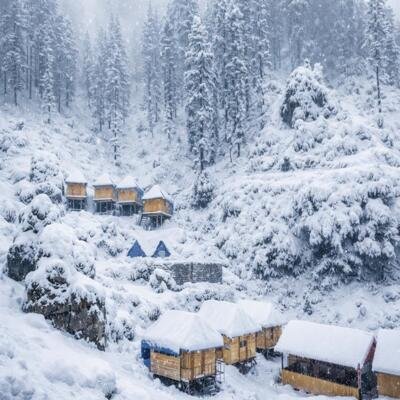
Winter changes Chakrata completely. Sound becomes sharper. Movement becomes slower. Every surface becomes cold-sensitive. Leaves crack underfoot. Grass turns white at dawn. Roads glisten with frost.
Walking in winter creates:
When snowfall happens, the entire environment shifts into stillness so deep it feels unreal. Roads empty. Sound disappears. Even wind slows. Movement becomes careful and minimal. Many travelers find winter the most psychologically powerful season in Chakrata.
Photography in Chakrata often begins with excitement and slowly turns into observation. Initially, travelers capture:
But over time, many stop picking up the camera. The landscape becomes something to watch rather than record. This transition from documentation to presence is one of Chakrata’s quiet gifts.
Photography here is not about producing proof. It is about learning how to look slowly.
Chakrata teaches people to listen before they see. Birds rarely appear openly. Their presence is announced through layered call patterns that echo across valleys and through tree corridors.
Forest sound includes:
Listening becomes an act of attention rather than background awareness. Over time, even visitors with no interest in birding begin recognizing distinctions between calls and patterns.
Chakrata naturally supports long, uninterrupted focus. With no nightlife pressure, no loud entertainment zones, and early evening silence, mental space expands.
People use this time to:
What makes this powerful is not comfort or luxury. It is the absence of demand. There is nothing calling you outward.
In Chakrata, doing nothing becomes a discipline. Sitting on a roadside bench, forest edge, ridge stone, or waterfall rock for an hour without checking time feels strangely natural.
Long sitting includes:
This is not passive laziness. It is active stillness. Few destinations allow this without creating restlessness.
Chakrata does not offer fixed experiences. It reshapes the same activities through seasons:
Each season removes one layer of activity and adds another layer of awareness.
Most destinations offer:
Chakrata offers:
This is why some travelers feel bored here in the first two days — and deeply transformed after five.
Chakrata does not entertain the mind.
It empties it first.
Life in Chakrata is shaped more by weather, altitude, military discipline, and forest silence than by commerce or tourism. Food, conversation, sleep timing, social behavior, and even walking habits follow an invisible order that visitors begin to sense within the first day. Unlike tourist towns that bend their rhythm around visitors, Chakrata asks visitors to bend toward its rhythm.
There is no pressure to consume experiences here. Instead, there is a quiet pressure to slow down, lower volume, and simplify needs. Over a few days, travelers notice themselves waking earlier, speaking softer, walking slower, and spending more time simply being present.
Food in Chakrata is not about variety or experimentation. It is about warmth, stamina, and digestion in a cold, high-altitude environment. Meals are designed to support the body through wind, walking, and winter rather than to excite taste in dramatic ways.
Most food revolves around:
Heavy restaurant-style cooking is rare. Portions are filling rather than decorative. Oil usage remains limited. The goal of food here is nourishment, not indulgence.
Eating schedules follow daylight rather than nightlife. Breakfast is early. Lunch is steady and functional. Dinner happens before cold fully takes over the evening.
Food in Chakrata changes naturally with climate:
In summer, digestion remains lighter. Meals include more vegetables, softer curries, and easier-to-digest grains. Hot food is still preferred, not for cold but for mountain digestion.
In monsoon, food becomes protective. Steamed dishes, boiled preparations, soups, ginger, garlic, and pepper-based flavors increase to guard against dampness and infection.
In winter, food becomes survival-driven. Ghee, thick lentils, potatoes, and heat-producing meals dominate. Portions increase slightly. Eating becomes a direct response to cold rather than appetite alone.
Winter meals are slow, warm, and deeply satisfying because they are tied to physical necessity.
Evenings in Chakrata revolve around one central need: warmth. As soon as sunlight disappears behind the ridge, cold arrives fast and deep. Wind increases. Shadows grow heavy. The town withdraws indoors almost instinctively.
Evening warmth rituals include:
People do not gather loudly for entertainment. They gather quietly for warmth. This makes evenings feel protective and inward, rather than social and outward-facing.
Civilian life inside Chakrata exists within the invisible boundary of a military environment. Even civilians unconsciously follow:
There is no culture of public display. People do not linger noisily on streets. Children walk calmly to school. Elders spend long hours sitting in sunlight rather than in cafés. Shops function quietly without aggressive sales pressure.
Chakrata feels like a town where nobody rushes and nobody pushes.
Beyond the cantonment-controlled area, small villages continue with older Himalayan rhythms that have changed very little over decades. Here, life is governed by:
Fields are terraced. Homes are stone-built. Labor is physical. Evenings arrive early. Electricity and network are not taken for granted.
For travelers, stepping into these village belts feels like stepping into a slower century, where time is counted in tasks, not clocks.
Human interaction in Chakrata is shaped by:
As a result, communication remains:
There is no loud bargaining culture. No forced friendliness. No artificial hospitality performance. Interactions feel real but restrained.
Travelers who behave loudly, dominate space, or show impatience feel instantly misaligned with the town’s emotional frequency.
Chakrata follows a deeply consistent daily rhythm that rarely changes:
Early Morning:
Cold, silence, breath visible in winter, birds more audible than people. Walks begin. Tea starts warming hands.
Late Morning:
Sun reaches ridges. Activity picks up. People move for work. Valleys open visually.
Afternoon:
Stillness returns in waves. People retreat indoors. Motion slows.
Evening:
Wind rises. Temperature falls sharply. Public spaces empty naturally.
Night:
Total silence. Deep darkness. Minimal road movement. Complete withdrawal from public life.
Within days, travelers begin to adjust to this rhythm without effort.
Chakrata demands behavioral sensitivity, not because of written rules but because imbalance becomes immediately visible.
Silence here protects:
Playing loud music, shouting across roads, or making unnecessary noise breaks the atmosphere far more strongly than in busy towns.
Photography must always respect:
Not everything seen should be captured. In Chakrata, restraint matters more than content.
Nature here is not just scenery. It is a living habitat. Responsible travel includes:
Once disturbed, silence takes years to return.
Chakrata is not built for night travel. After sunset:
Late-night wandering is strongly discouraged by the atmosphere itself.
Chakrata does not hide its limitations:
Anyone arriving here must come with mental and physical preparedness, not expectation of instant convenience.
Chakrata works deeply for:
It cannot satisfy:
Chakrata never overwhelms.
It empties slowly.
It trains the body to:
People often leave Chakrata speaking less, checking phones less, and breathing deeper. The town does not give excitement as a takeaway.
It gives slowness as memory.
And that memory stays long after the journey ends.

Escape the city rush with a refreshing strong data-end data-start Chakrata Tour Package from Delhi strong ...
Per Person
Showing 1 of 1 pages
The nearest airport is at a distance of 113 km which is Jolly Grant airport. From the airport, you can get local transport and cabs to reach your destination. There are well-motorable roads that connect Chakrata to other cities.
An ideal opportunity to visit Chakrata is the month from April to June and again from September to November. From the long stretch of June till September this spot encounters precipitation thus the climate isn't ideal to wander around. The summer season is the best and ideal opportunity to do exercises like Trekking, fowl watching, and outdoors in Chakrata.
During the summer season, temperature of Chakrata remains normal from 10°C up to 30°C. During the monsoon season, which is from July till September it receives rainfall up to 178 cm per annum. During the winter season, Chakrata remains very chilly and experiences the temperature from 5°C to 15°C. It also receives heavy snowfall during the winter season.
Chakrata has mountain ranges that offer adventure activities like mountain climbing. Here you can also explore some of the prominent attractions such as Tiger Falls, Deoban, Budher Cave, Chilmiri Neck, and Ram Tal Horticultural Garden. All these attractions can be covered in the timespan of 2 days.
Mundali has rich green woodland and glorious snow-shrouded tops. The inclines here offer vacationers to enjoy skiing. Journey darlings can likewise have a stroll around the backwoods in the magnificence of nature. Every one of these things makes it an ideal spot for adventure lovers.
Chakrata is a quiet hill station and it doesn't have any sort of contamination. The eastern side of Chakrata lies in Mussoorie and the western side of Chakrata lies in Kinnaur of Himachal Pradesh. Chakrata offers the best spot to nature darlings, experience sweethearts, and love to watch birds and wildlife. Throughout the colder time of the year season, Chakrata stays covered under the sheet of the day off. You can have the best all-encompassing perspective from the high purposes of Chakrata.