
To More Inquiry





Binsar: A paradise of forests, views, and wildlife
Binsar is a high-altitude forest destination of the Kumaon Himalayas, known for its deep silence, wildlife sanctuary, vast deodar and oak forests, and uninterrupted Himalayan views. Unlike popular hill stations built around markets, hotels, and fast tourism, Binsar exists primarily as a forest ecosystem with human presence at the edges. It is not a place that announces itself loudly. Its character unfolds slowly through misty mornings, bird calls, shaded trails, and long hours of quiet observation.
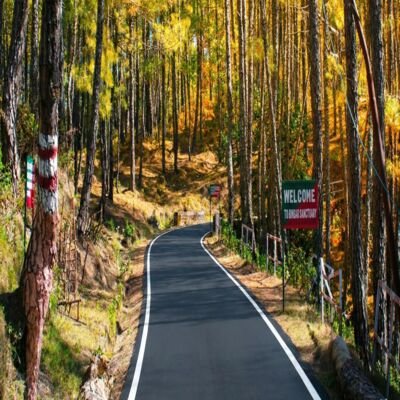
Perched on a mountain ridge above Almora, Binsar feels emotionally distant from urban life even though it is geographically not far from a working town. The moment travelers cross the forest entry gate, the world changes. Traffic noise fades, mobile signals weaken, and the landscape shifts into dense woodland. Roads narrow, trees rise tall on both sides, and movement becomes instinctively slow.
Binsar does not entertain in the conventional sense. There are no malls, no crowded cafés, and no fixed sightseeing circuits. What it offers instead is space, silence, forest depth, and mental stillness. Travelers come here not to collect attractions but to shed noise.
Binsar is located in the Kumaon region of Uttarakhand, positioned on a forested ridge above the town of Almora. The core of Binsar falls within the protected boundaries of the Binsar Wildlife Sanctuary. This single factor defines almost everything about the destination—its silence, rules, movement, and pace of life.
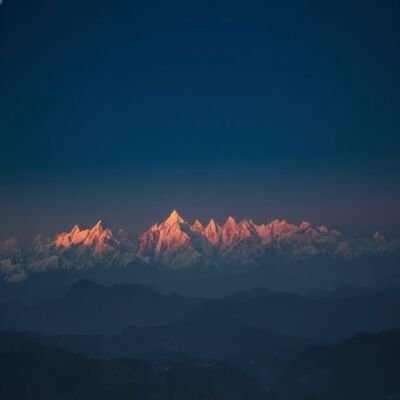
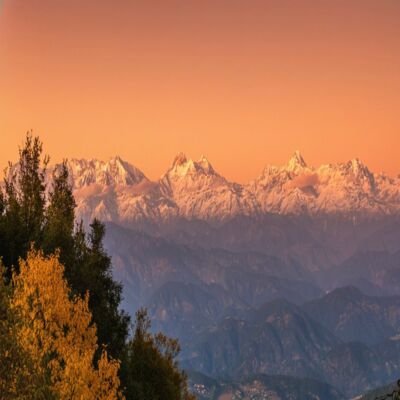
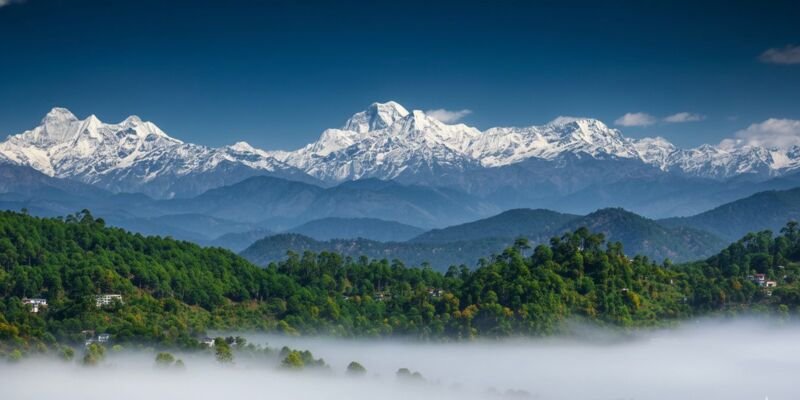
The sanctuary spreads across a large forest zone with sharp ridgelines and deep valleys falling on multiple sides. Because of this elevation and open ridge position, Binsar offers some of the most direct panoramic views of the central Himalayan ranges when weather conditions remain clear.
Unlike valley towns that feel enclosed, Binsar always feels exposed to sky, wind, and distant mountain horizons.
Key location characteristics of Binsar include:
This location makes Binsar a destination that feels geographically open but socially isolated.
Binsar is not a town, a village cluster, or a resort hub in the traditional sense. It is primarily a protected forest region with limited human settlement. Most travelers stay inside forest lodges, eco-stays, or houses built along the forest edges. Life here is dictated by sunlight hours, forest rules, and weather rather than commercial schedules.
The destination’s identity grows from:
This makes Binsar fundamentally different from hill stations like Nainital, Almora, or Ranikhet. Those places evolve around markets and roadside life. Binsar evolves around trees, trails, and quiet.
The first emotional impression of Binsar is usually one of sudden separation. The forest gate acts as both a physical and psychological boundary. Once inside, the mental pace drops. Sounds soften. Conversations reduce naturally. Even walking speed slows down.
The air feels cooler and heavier with forest moisture. Light filters through tree canopies in broken patches. Houses appear scattered rather than clustered. At night, darkness settles fully, without urban light pollution.
Many travelers realize within a few hours that Binsar is not meant for fast consumption. It is meant for absorption.
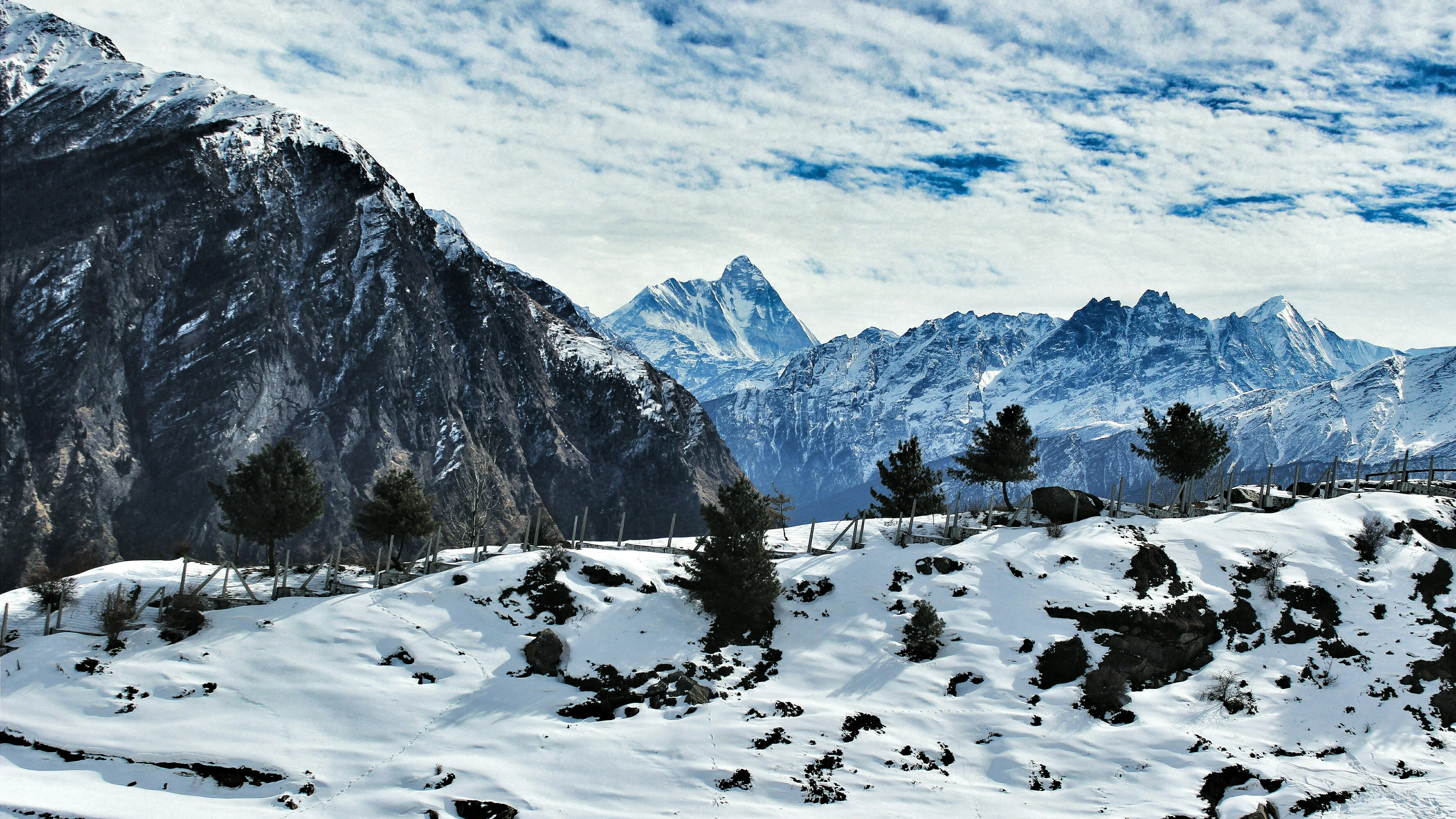
Binsar’s visual character is built around two dominant elements: dense forest interiors and sudden open ridge viewpoints. Inside the forest, visibility is limited to tree trunks, moss-covered ground, shaded trails, and drifting light. Then, without warning, a trail opens into a cliff edge where the Himalayan ranges rise across the entire horizon.
This visual contrast creates a powerful emotional effect. The world feels closed and then suddenly infinite.
Mornings are often misty. Midday light becomes sharp along ridges. Evenings fill with slow-moving cloud shadows across valleys. Nights return the forest to complete darkness.
Binsar’s visual environment is defined by:
Binsar is not built for social tourism. It is built for isolation without danger. Travelers remain safe, housed, and nourished, yet emotionally removed from crowd behavior. There are no markets to wander endlessly, no street food lanes to follow, and no nightlife to chase.
Instead, silence becomes the dominant experience:
This type of silence is not empty. It is full of soundless movement—wind, leaves, distant birds, and breathing.
Binsar attracts a very specific category of traveler. People who arrive here expecting entertainment often feel restless. People who arrive seeking quiet usually feel relief within hours.
Binsar naturally draws:
It does not naturally suit:
Within the broader Kumaon travel landscape, Binsar plays the role of a quiet forest retreat rather than a tourist hub. Almora acts as the cultural center. Nainital acts as the leisure center. Ranikhet acts as a cantonment hill retreat. Binsar acts as the forest isolation zone.
Many travelers visit Binsar after passing through Almora, not before. This sequence matters emotionally. Almora prepares the mind with culture and walking. Binsar completes the journey with silence and removal.
Binsar does not compete with towns. It complements them by offering the opposite experience.
Binsar is positioned on a high forested ridge in the Kumaon Himalayas, rising above deep valleys that fall sharply on multiple sides. This ridge-based geography gives Binsar its signature character—a destination that feels suspended between sky and forest. Unlike valley towns that grow along rivers or roads, Binsar grows along elevation, wind flow, and tree lines.
The terrain is not uniform. It shifts constantly between steep forested slopes, narrow ridgelines, soft alpine clearings, and sudden cliff edges that open into vast Himalayan views. Some stretches feel tightly enclosed by dense trees, while others feel dramatically open with the horizon stretching endlessly.
This varied terrain controls:
Because of this, every short walk in Binsar feels physically different from the last.
Binsar sits at a high elevation where temperature, oxygen levels, and wind flow change noticeably compared to nearby towns like Almora. The ridge position allows strong air circulation, which keeps the environment cool, fresh, and constantly moving.
The ridge structure also creates:
This high-altitude geography gives Binsar its dramatic weather personality and deep sense of remoteness.
Binsar exists in a rare geographical balance where three major visual layers coexist simultaneously:
From many points within the forest, the world feels enclosed. From a few exposed ridges, the world feels infinite. This continuous switch between enclosure and openness becomes one of the most powerful emotional experiences of Binsar.
On clear days, long mountain ranges appear stacked across the horizon. On cloudy days, the valleys vanish beneath rolling mist while only nearby ridge lines remain visible.
This layered geography makes Binsar a destination where visibility itself becomes a changing experience, not a permanent feature.
The heart of Binsar lies within the wildlife sanctuary zone, which acts as both a conservation area and a travel environment. The sanctuary is not fenced in simple geometric boundaries. It follows natural forest spread, ridge lines, and valley contours.
Inside the sanctuary, the natural landscape is divided loosely into:
Each of these landscape types supports a different kind of movement and sensory experience. Dense interiors feel silent and shaded. Alpine pockets feel wind-driven and open. Ridge-tops feel exposed and vast.
Human activity inside the sanctuary is limited and regulated. This allows the forest to remain active, living, and self-sustaining rather than decorative.
Binsar’s forest holds multiple natural springs and seasonal mountain streams, though they often remain hidden beneath dense vegetation. During the monsoon, water flows increase significantly, and stream sounds begin to dominate the forest soundscape.
In summer, many of these water sources recede, returning silence to the undergrowth. Wildlife movement increases near remaining water pockets. These water systems play a crucial role in maintaining both forest life and the nearby village's survival.
Though travelers rarely see open rivers in Binsar, water remains one of the invisible forces shaping forest behavior.
Binsar’s forest is not uniform. It shifts by altitude, slope direction, soil depth, and sunlight exposure. As a result, travelers pass through clearly defined forest zones during walks.
The dominant forest types include:
Each forest type creates a distinct atmosphere. Oak zones feel heavy and silent. Pine zones feel airy and light-filled. Deodar belts feel ancient and cathedral-like.
This botanical diversity is one of the reasons Binsar supports such strong bird and animal life.
Binsar is not a preserved museum forest. It is a living, breathing ecological system where trees, birds, insects, animals, fungi, and soil operate in constant balance. Leaves fall, trees regenerate, dead wood feeds insects, and animals recycle nutrients back into the forest floor.
Human presence exists only at the fringe of this system. Travelers remain visitors inside a much older and larger biological network.
Daily ecological activity includes:
This movement is subtle. It becomes visible only when one stays still long enough.
While Binsar is not known for dramatic large-animal tourism, it supports a healthy population of small and medium-sized wildlife species. These animals remain mostly hidden inside dense forest belts and appear primarily during early morning, evening, or quiet weather conditions.
Wildlife behavior follows:
Rather than functioning as an attraction, wildlife presence here acts as a silent reminder that the forest belongs to itself first.
Binsar’s geography directly controls how travelers behave, move, and feel:
There is little room for fast tourism here. The land itself demands slow movement, cautious walking, and long pauses.
Travelers do not simply visit Binsar. They gradually adjust to it.
The history of Binsar is not the history of a town or kingdom. It is the history of forest life and scattered human settlements, shaped slowly over centuries. Long before forest protection laws and sanctuary boundaries existed, small communities lived along the fringes of this dense woodland. Their lives were tied closely to grazing routes, water sources, wild herbs, and sacred forest spaces.
These early settlers did not build large towns. Instead, they created compact village clusters and seasonal shelters, allowing the forest to remain largely undisturbed. The rhythm of life was dictated by weather, animal movement, forest growth, and seasonal migration between lower and higher altitudes.
Over time, trails formed between grazing grounds, temples, and water points. Many of today’s forest paths follow the same routes used for generations.
Binsar’s spiritual history grew directly from the forest environment. Ancient hill cultures across Kumaon treated high ridges, old trees, caves, and rock formations as sacred long before formal temples were constructed. Forest deities, mountain guardians, and nature-based worship predate structured religious institutions here.
The most significant spiritual landmark in the region is Binsar Mahadev Temple, dedicated to Lord Shiva. This temple stands on a high forest ridge and commands panoramic views of the surrounding valleys and distant Himalayan peaks. Over centuries, this temple became a central point of devotion for nearby villages and highland travelers.
Rather than functioning as a large pilgrimage hub, Binsar’s spiritual setting remains quiet, personal, and locally grounded. Worship is integrated into daily life rather than organized as a crowd event.
Due to its isolation, silence, and spiritual associations, Binsar gradually evolved into a natural retreat space for meditation and reflection. Long before modern retreat culture existed, sages, seekers, and wandering ascetics passed through this forest region seeking solitude and connection with the mountain environment.
The forest offered:
This meditative quality remains the same today. Even modern travelers often report an unexpected emotional slowing during long forest stays in Binsar.
Villages surrounding Binsar maintain a long-standing cultural relationship with the forest. For generations, they depended on the forest for:
In return, the forest shaped community discipline through:
This mutual dependence created a strong culture of respect rather than exploitation, a relationship that continues in adapted form even after conservation regulations were introduced.
During the regional kingdom rule in Kumaon, Binsar functioned primarily as a sacred forest area rather than an administrative center. While nearby towns grew under royal influence, Binsar remained largely unchanged due to its temple's importance and thick forest cover.
Under British administration, many forest regions of Kumaon were surveyed and brought under management. Paths improved, forest laws emerged, and the region gradually came into administrative consciousness. However, due to difficult access and limited economic activity, Binsar was not transformed into a hill town like others.
This relative isolation allowed Binsar to retain its pre-modern forest identity well into the twentieth century.
In modern times, Binsar’s ecological and cultural value led to its declaration as a protected wildlife sanctuary. This legal status further restricted construction, large-scale settlement, and commercial activity.
With sanctuary status:
This marked a turning point where Binsar shifted fully from a living forest and temple settlement to a controlled conservation landscape with spiritual roots.
Today, Binsar’s culture is neither traditional village life nor modern tourist town culture. It exists in an in-between state:
There are no loud festivals here, no mass market days, and no urban celebration culture. Cultural expression stays subdued, inward-facing, and seasonal.
Even in modern times, Binsar feels like a place where time moves differently, slower and more circular rather than fast and linear.
Many visitors describe Binsar less in terms of landscape and more in terms of energy and mental effect. The forest silence, high ridge exposure, and sense of separation from towns create a psychological environment that naturally pushes attention inward.
This is not religious in a doctrinal sense. It is more:
Binsar does not instruct meditation. It gently forces it through the surroundings.
Binsar experiences a true high-altitude forest climate, shaped by dense tree cover, ridge-top exposure, deep surrounding valleys, and strong seasonal wind movement. Unlike low hill towns that follow gentle seasonal transitions, Binsar’s weather changes quickly, sharply, and with strong emotional impact. Temperature, visibility, and soundscape can shift within hours.
The forest significantly regulates temperature. During summer, shade beneath oak and deodar trees keeps the air cooler than nearby towns. During winter, the same forest traps cold air, intensifying chill after sunset. Cloud formation is frequent due to ridge exposure, and mist can appear suddenly even on otherwise clear days.
Binsar’s climate never feels static. It constantly reminds travelers that they are staying inside a living mountain ecosystem, not a climate-controlled destination.
Summer is the most comfortable and widely preferred season to visit Binsar. Temperatures remain cool, forest shade remains deep, and long daylight hours allow slow exploration without physical strain. Unlike plains where summer feels harsh, summer in Binsar feels soft, breathable, and green.
Mornings begin crisp and quiet with bird calls and filtered sunlight through tall trees. Afternoons remain pleasant even in direct sun due to altitude and air movement. Evenings cool down quickly, returning the forest to silence.
This is the season when:
Summer supports both physical movement and emotional rest.
Monsoon transforms Binsar into a mist-dominated cloud forest. Rain arrives frequently, and dense fog often moves through treetops and ridges. Visibility drops sharply, sometimes limiting views to just a few meters ahead. The forest becomes intensely green, wet, and heavy with moisture.
Walking during the monsoon requires caution. Trails become slippery, leeches appear near water pockets, and ridge paths demand slow footwork. Distant Himalayan views almost completely disappear behind thick cloud cover.
However, for travelers who enjoy:
Monsoon becomes a profoundly immersive experience. It is not a sightseeing season. It is a listening season where sound and smell replace vision.
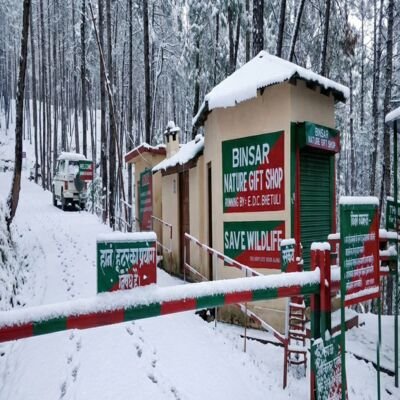
Winter in Binsar is long, cold, and starkly beautiful. October begins with clear skies and rising cold. November deepens the chill. December to February bring sharp night cold, frost-covered paths, and occasional snowfall.
Unlike high-snow destinations where winter tourism becomes activity-driven, winter in Binsar remains still and inward-facing. Days remain bright but cold. Nights arrive early, and darkness settles completely due to low light pollution.
Winter is ideal for:
This is the season when Binsar feels most removed from the outside world.
There is no single “best” time to visit Binsar because the destination serves different emotional and experiential purposes across seasons. The correct time depends on what the traveler seeks from the forest.
The most comfortable months for long walks, ridge exploration, and physical movement are:
During these periods:
These months are ideal for travelers who want to experience the forest physically.
Binsar offers stunning Himalayan views, but visibility is entirely season-dependent. The clearest mountain views appear during:
This period offers:
Monsoon months almost completely block Himalayan visibility.
For travelers seeking complete emotional isolation and internal quiet, the most powerful seasons are:
During these months:
These months are ideal for writers, spiritual seekers, and long-stay travelers.
Bird activity remains high throughout the year, but the most rewarding periods are:
During these months:
Binsar never experiences extreme crowds, but low-human movement peaks during:
These months offer:
However, movement and comfort may be reduced due to weather severity.
Every season in Binsar carries natural limitations:
Understanding these realities helps travelers choose Binsar for the right reasons rather than random timing.
Binsar does not present its attractions as crowded landmarks. Its most meaningful places emerge quietly from forest clearings, ridgelines, temples, and silent viewpoints. The experience of each place is shaped as much by silence and light as by physical form.
Zero Point is the highest accessible viewpoint inside the sanctuary and the most dramatic opening of the Himalayan skyline. From here, the forest suddenly drops away to reveal vast snow-covered ranges on clear days.
The walk to Zero Point itself passes through dense forest, increasing the emotional contrast when the horizon suddenly opens.
Why Zero Point feels powerful:
This ancient temple sits quietly on a forest ridge, surrounded by tall trees and open sky. It holds both spiritual and geographic significance. Devotees visit slowly and quietly, without crowd movement.
The temple area also works as a silent sitting zone where travelers pause after long forest walks.
Why this temple feels different:
The core sanctuary areas are not fixed sightseeing points but living forest corridors. These zones offer shade-heavy walking trails, sudden light patches, sound-dominated movement, and natural ecological encounters.
Walking here is about immersion rather than destination.
What defines core forest walking:
Several unnamed ridges within Binsar face the eastern horizon. These slopes offer layered sunrise views over forest and valley depths. Light spreads slowly across ridges, tree tops, and distant peaks.
Travelers often discover their own sunrise spot through repeated morning walks.
Why Sunrise Ridges feel special:
Western slopes around Binsar provide long sunset observation. The forest gradually darkens while the sky remains luminous. Cloud movement becomes visible as silhouettes against fading light.
These slopes offer wide sitting spaces and uninterrupted wind flow.
Why sunset watching feels different here:
Binsar’s deeper charm lies in what is not marked. Many of its most powerful experiences come from unlabelled forest trails, shepherd routes, and silent ridgelines.
These narrow paths were once used for grazing and seasonal movement. They now act as the quietest walking routes for travelers seeking complete isolation.
What makes Shepherd Trails unique:
Certain low-lying pockets inside the forest remain protected from wind and ridge exposure. These areas stay warmer in winter and cooler in summer.
They are ideal for:
Some old forest watch towers now remain unused. These structures sit on clear ridges with wide valley drops. They offer solitary panoramic views without crowd presence.
At higher points, forest density breaks into soft grassy open zones. These are rare spaces where the sky dominates more than the trees.
Why these clearings feel rare:
Binsar is not defined by classical “activities.” Most experiences are slow, repetitive, and emotionally layered rather than event-based.
Forest walking forms the backbone of Binsar travel. Walks vary from gentle shaded paths to long ridge climbs.
Why walking defines Binsar:
Even without visual sightings, sound becomes a major experience. Early mornings fill with layered bird calls across forest depths.
This makes Binsar a destination where:
During monsoon and early winter, clouds move directly through forest corridors. Watching mist fill an empty valley,s becomes a repeating visual experience.
Many travelers naturally build daily routines around sunrise and evening sitting. These moments anchor the slow travel rhythm.
Binsar supports inward-focused practices without structured schedules. Silence itself becomes the guide.
Why inner practices feel natural here:
Binsar is especially supportive of:
The absence of external noise strengthens creative concentration.
During winter, forest paths turn white with frost. Walking during late morning offers crisp light, frozen vegetation textures, and heavy quiet.
With minimal artificial lighting, night skies appear darker and deeper. Stars become visible on clear winter nights, and forest darkness feels complete.
Each season reshapes both movement capacity and emotional tone.
Food in Binsar follows the same philosophy as the forest itself—simple, seasonal, warm, and quiet. There is no loud dining culture, no food streets, and no competitive restaurant environment. Meals here exist to nourish the body in a cold, high-altitude climate, not to entertain the senses with excess variety.
Most travelers eat where they stay. Food timings follow daylight rather than late-night schedules. Breakfast begins quietly after sunrise. Lunch is unhurried. Dinner settles in early with the cold.
Eating in Binsar becomes part of the slow rhythm rather than a separate activity.
Daily meals are built around:
Flavors remain soft and comforting. Heavy frying and intense spice rarely dominate. This style of eating suits both the climate and digestion during long forest stays.
Food naturally changes with the weather:
As the temperature drops, meals become more heat-producing and energy-focused.
Hot tea, herbal drinks, and warm milk-based beverages appear throughout the day. Morning tea sets the tone for the day. Evening tea becomes a silent social moment as forest darkness starts to fall.
These warm drinks act as:
Unlike tourist hubs where dining becomes social entertainment, eating in Binsar feels:
Many travelers eat with minimal conversation, listening instead to forest sounds through the windows.
Binsar itself does not function like a conventional town. Human life exists mainly in small villages and forest-edge settlements. These communities live in close coordination with climate, forest rules, agriculture, and seasonal movement.
Local villagers depend on:
Life here is practical and climate-driven. Mornings start early. Work follows sunlight. Evenings end quickly with darkness.
Local communication uses regional mountain dialects along with Hindi. Speech remains:
Aggressive sales behavior is almost absent. Interaction feels honest rather than commercial.
Small temples and forest-edge shrines appear quietly along paths and village borders. Worship remains integrated with daily routine rather than festival-driven.
Religion here feels protective rather than celebratory.
During extreme winter, some villagers move toward lower altitudes for work and warmth. In summer, activity rises again around agriculture and seasonal travel.
This altitude-based migration is a long-standing survival pattern across the region.
Binsar is not only a travel destination. It is a protected ecological and spiritual space. Traveler behavior directly affects both forest balance and local life.
Silence is the primary rule of Binsar:
Quiet behavior is not suggested—it is essential.
Waste removal from deep forest areas is limited. Every plastic wrapper, bottle, and food packet becomes a long-term burden.
Responsible behavior includes:
Wild animals are not attractions. They are residents. Chasing, noise-making, feeding, or photography without distance disturbs their natural movement.
Visitors are guests inside a living ecosystem.
Forest terrain demands:
Forest safety is based on patience, not speed.
Village areas are not open picnic zones. Fields, livestock spaces, and homes follow social boundaries. Photography, entry, and interaction must always remain respectful.
Binsar offers profound calm, but it also carries natural difficulties that travelers must accept fully:
Binsar does not compensate for inconvenience with luxury. It replaces convenience with stillness.
Binsar feels deeply rewarded for:
It often feels frustrating for:
Binsar rarely creates excitement in the first few hours. Instead, it works slowly, quietly, and deeply. The emotional change does not come from attraction hopping. It comes from repetition:
After a few days, the mind drops speed. Attention lengthens. Thoughts become simpler. Noise disappears.
Binsar does not entertain.
It empties.
And in that emptiness, many travelers find the most lasting memory.

Discover the tranquil beauty of the Himalayas with the strong data-end data-start Binsar Tour Package from ...
Per Person

Experience the serene beauty of the Kumaon Himalayas with the strong data-end data-start Almora Binsar Tour ...
Per Person
Showing 1 of 1 pages
While being on a Binsar tour you can explore some of the fascinating destinations that are located in proximity. If you extend your days in the Binsar tour package then you can explore some of the beautiful hill stations such as Bageshwar, Kausani, Jageshwar, Jalna, Katarmal etc.
Pantnagar Airport is the nearest airport located at a distance of 152 kilometers from Binsar you can get a direct flight from Delhi International Airport. The nearest railway station is located at Kathgodam which is at a distance of 130 km and can be covered in the time span of 2 hours and 40 minutes.
The best and ideal time to visit Binsar is throughout the year as the climate stays wonderful consistently. During winter months the excellence of Binsar gets improved as the ground is covered with a white day off, and seeds with blossoms give a marvelous view. Winter is the ideal opportunity for bird watchers and especially night lovers.
Some of the famous restaurants, serving really good local cuisines in Binsar are Dolma Restaurants, Hotel Narendra Palace, Kaafal Cafe, The Kasar Kitchen, Anjana, Garden Restaurant, and Swarnika Restaurants. There is a huge variety of accommodations in Binsar and the tourist can choose as per their requirement from budget hotels to luxury hotels.
The temperature of Binsar throughout the late spring month stays typical, from 15°C to 30°C. It gets the normal precipitation during the rainstorm month. It stays freezing and crisp throughout the colder time of year month and the temperature goes from 0°C to 20°C. You need to convey your light woolens throughout the mid-year month and weighty woolens during the period of winter.
Binsar, also known as the paradise for bird watchers, also has some of the prominent tourist attractions that can be visited. Some of the major attractions in Binsar are Mahadeva temple, Mary Budden estate, Binsar Sanctuary Museum, and Golu Devta Temple. The trip to Binsar can be enjoyed for a minimum of 2 days.
Binsar, also known as the paradise for bird watchers, also has some of the prominent tourist attractions that can be visited. Some of the major attractions in Binsar are Mahadeva temple, Mary Budden estate, Binsar Sanctuary Museum, and Golu Devta Temple. The trip to Binsar can be enjoyed for a minimum of 2 days.